
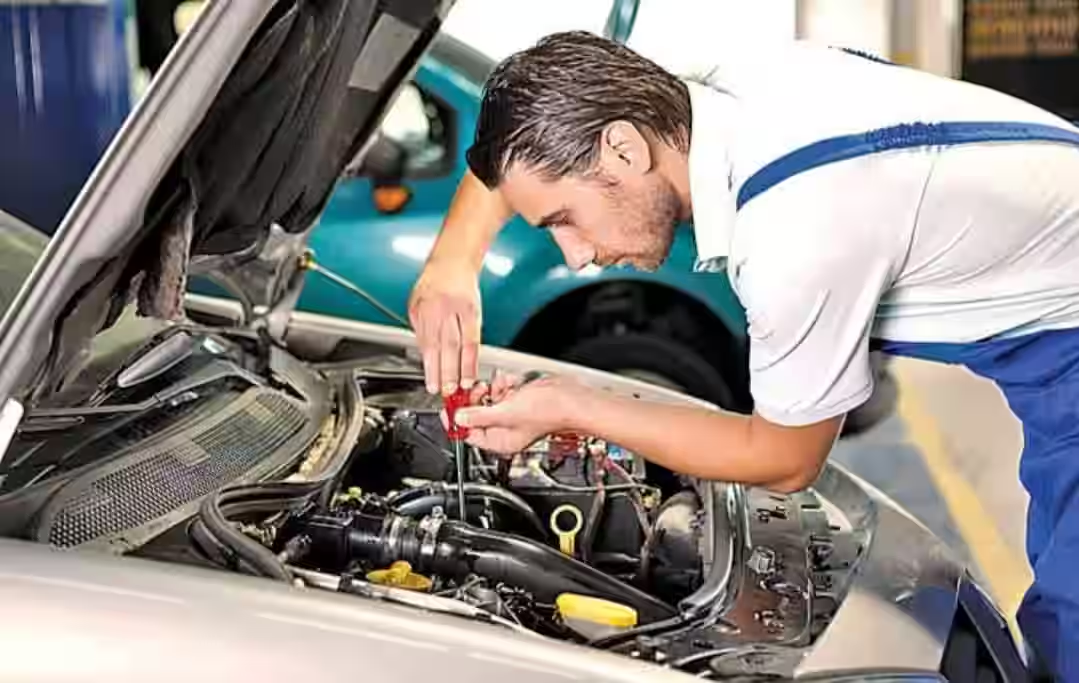
The modern automotive repair landscape has transformed dramatically. No longer confined to replacing worn-out parts or fixing simple mechanical failures, advanced car repair today demands a blend of data science, artificial intelligence, and electronic system mastery. As vehicles evolve into rolling computers, the repair industry must adopt sophisticated techniques to ensure precision, efficiency, and long-term vehicle health. This article explores how predictive diagnostics, sensor-driven analytics, and AI-powered systems are reshaping the way professionals approach car repair in the 21st century.
The Evolution from Reactive to Predictive Repair
For decades, vehicle repair was reactive—technicians responded to breakdowns after they occurred. However, with the emergence of smart sensors and telematics, predictive repair has become the gold standard. Predictive diagnostics use real-time data to foresee failures before they disrupt vehicle performance. This approach relies heavily on data streams from the car’s onboard systems, helping repair specialists diagnose anomalies long before they cause a malfunction.
Key components of predictive repair include:
-
Continuous monitoring of system performance through IoT-enabled sensors
-
Data modeling to detect irregular vibration, temperature, or voltage patterns
-
Early intervention strategies based on algorithmic predictions
By integrating predictive maintenance software into workshop operations, car repair professionals can minimize unexpected failures, enhance customer satisfaction, and build data-rich service records for each vehicle.
Advanced ECU Programming and Software Reconfiguration
Today’s cars run on millions of lines of code. The electronic control unit (ECU) governs crucial functions—engine timing, transmission behavior, fuel injection, and even climate control. When a repair involves replacing or modifying components that interact with these systems, software recalibration becomes mandatory.
Technicians must not only repair the hardware but also reprogram or “flash” the ECU to communicate correctly with new parts. This process requires specialized diagnostic equipment and secure access to OEM software databases. Ignoring ECU recalibration can lead to misfires, warning lights, or reduced fuel efficiency.
Advanced ECU reconfiguration involves:
-
Updating or rewriting ECU firmware after hardware replacement
-
Coding and parameter setting for adaptive systems like ABS or ADAS sensors
-
Verifying the handshake between subsystems (e.g., engine-transmission pairing)
Workshops that fail to invest in digital calibration risk falling behind, as future vehicle systems will rely almost entirely on networked software logic.
Integrating AI for Fault Pattern Recognition
Artificial intelligence is no longer a buzzword—it’s a working tool in advanced repair facilities. AI-based diagnostic systems analyze huge datasets collected from similar car models, identifying repeating fault patterns that human technicians might miss.
For instance, if several vehicles of the same make and model show recurring throttle actuator faults after 70,000 miles, AI tools can proactively alert repair centers. This insight allows workshops to prepare replacement parts in advance or recommend preventive measures to customers before failure occurs.
Benefits of AI integration include:
-
Enhanced accuracy through deep learning fault prediction
-
Shorter diagnostic time and reduced part misidentification
-
Real-time updates for new software or sensor-related issues
Machine learning algorithms can also assist in adjusting torque specs, tuning parameters, and optimizing repair workflows based on historical performance data.
Thermal Imaging and Non-Invasive Component Testing
Another game-changing innovation in professional car repair is the use of thermal imaging and non-destructive testing (NDT). These technologies allow technicians to detect electrical faults, heat loss, or hidden component degradation without disassembling the system.
Thermal cameras visualize heat distribution across components, revealing issues like poor grounding, bearing wear, or internal resistor damage. Combined with voltage drop testing, this approach eliminates guesswork and reduces labor hours.
Common applications include:
-
Detecting hot spots in electrical circuits or battery cells
-
Locating air leaks in HVAC systems or turbo piping
-
Assessing brake rotor balance and temperature uniformity
By integrating these diagnostic imaging tools, repair centers can deliver faster, data-backed solutions that build customer trust and transparency.
Chassis and Structural Health Monitoring Systems
Modern vehicles are engineered with ultra-high-strength steel, aluminum, and composite materials that demand specialized repair methods. Structural health monitoring (SHM) involves evaluating the integrity of the chassis using acoustic sensors and strain gauges that detect minute deformations.
After collisions or high-impact events, traditional frame measurement may not reveal micro-cracks or stress zones. Advanced SHM systems use vibration analysis and ultrasonic scanning to assess hidden damage that could compromise safety.
Core aspects of SHM-based repair include:
-
Digital measurement of chassis alignment through laser scanning
-
Sensor-based fatigue analysis for suspension and steering assemblies
-
Post-repair recalibration of load-bearing sensors and stability systems
By incorporating SHM technologies, workshops can go beyond cosmetic repairs, ensuring structural safety and compliance with manufacturer specifications.
Sustainable and Modular Repair Strategies
Sustainability is becoming a driving force in the repair sector. The focus is shifting toward modular repair, where individual electronic modules or sections are replaced rather than entire systems. This not only reduces costs but also minimizes electronic waste.
Hybrid and electric vehicles, in particular, benefit from modular diagnostics. Instead of replacing an entire battery pack, technicians can isolate weak cells through voltage mapping and replace only the affected modules.
Advantages of modular repair include:
-
Lower environmental impact through reduced part replacement
-
Extended component life cycles via localized refurbishment
-
Improved cost efficiency and shorter repair turnaround
Adopting modular repair strategies requires technicians to understand system architecture, sensor interconnectivity, and safe handling of high-voltage circuits.
The Human Element: Re-Skilling and Continuous Learning
Technology may dominate the conversation, but skilled human interpretation remains essential. The complexity of modern vehicle systems means technicians must continuously learn to integrate mechanical expertise with digital literacy.
Workshops that prioritize continuous training programs for their staff will have a competitive advantage. Collaborations with OEM academies and certification programs ensure that repair professionals remain proficient with evolving technologies, including electric propulsion systems, lidar sensors, and V2X communication modules.
In essence, the future of car repair belongs to hybrid technicians—those who merge diagnostic intelligence with craftsmanship.
FAQs About Advanced Car Repair
1. How does predictive maintenance differ from traditional repair methods?
Predictive maintenance anticipates issues before they occur using data analytics, while traditional methods focus on fixing problems after they arise.
2. Why is ECU reprogramming necessary after component replacement?
Because most components communicate through the ECU, any hardware change requires recalibration for optimal synchronization and accurate system operation.
3. Can AI diagnostics replace human technicians?
No. AI assists by recognizing patterns and suggesting solutions, but skilled technicians are essential for interpretation and practical application.
4. What makes thermal imaging valuable in auto repair?
It allows non-invasive detection of heat-related issues, saving time and reducing unnecessary part replacements.
5. Are structural health monitoring systems standard in all vehicles?
Not yet. They’re currently found in high-end and commercial vehicles, but the technology is rapidly being adopted by mainstream manufacturers.
6. How do modular repairs support sustainability?
They reduce waste by replacing only defective modules instead of full assemblies, conserving materials and energy.
7. What skills will future auto technicians need most?
They’ll need strong foundations in electronics, data interpretation, AI-based diagnostics, and safe handling of electric vehicle systems.